
Banknote identifier app: scan a note, see what it's worth
Photograph a banknote front and back to learn its country, denomination, series and estimated value. Buck is free to download; app scans need Buck Pro.
A banknote identifier tells you what a note is from a photo of both sides: the country, the denomination, the series or period, and an estimate of what it is worth where a price guide has one. Most notes people find are worth their face value or close to it; a dealer settles the ones that might be worth real money.
Buck is a banknote identifier and coin identifier for iPhone (iOS 17 or later) and Android (8.0 or later). It is free to download. Browsing the catalog and keeping a collection cost nothing; scanning in the app needs Buck Pro, $39.99 a year or $5.99 a week (US stores, checked 3 November 2026), with no free trial.
The scanner below takes a photo of the front and one of the back of a single note, a few scans a day, and answers with its name and, where the price guide has one, an estimated value. On common current euro and UK notes the scanner shows the face value and no estimate.
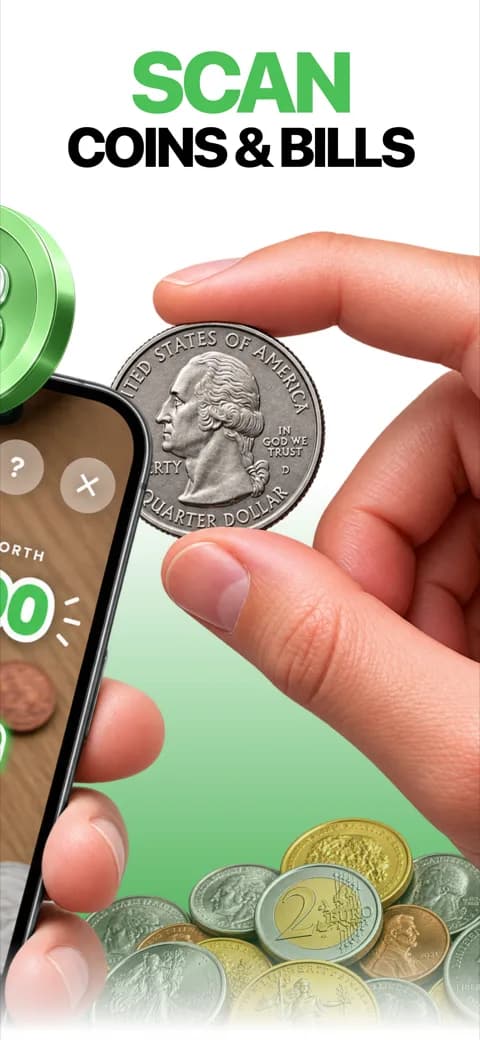
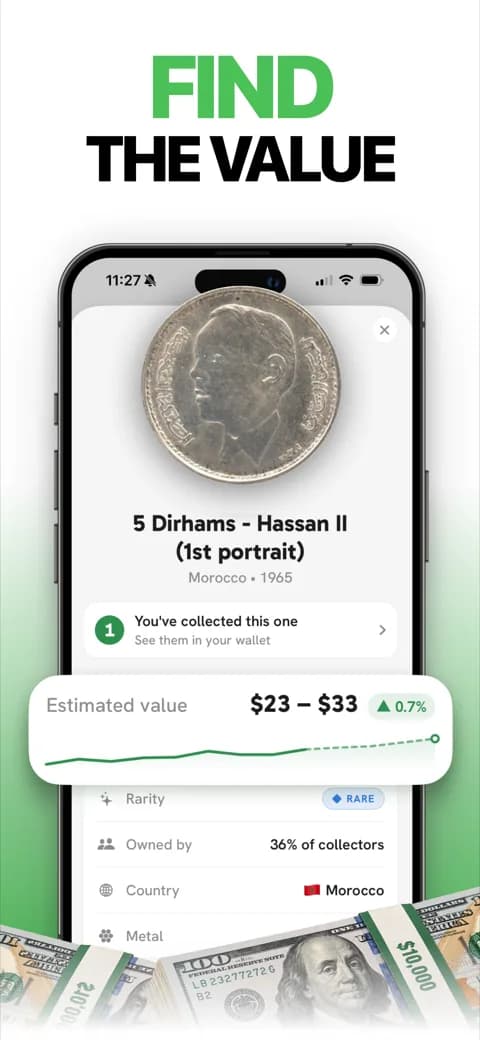
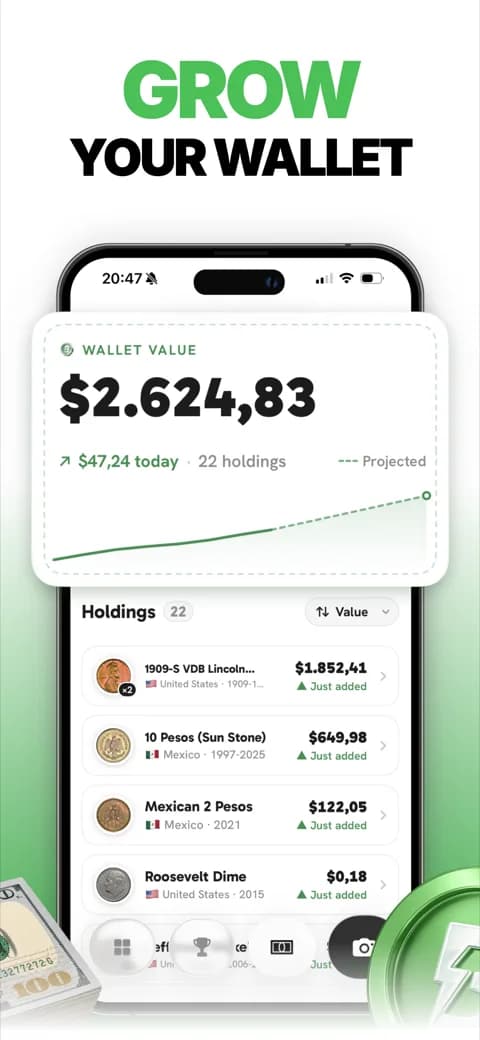
What a banknote identifier scan gives you
- Country and denomination. Named from the photos of both sides.
- Series or period. For a design printed over many years, the span the catalog holds for that type.
- An estimated value. A range where the price guide has one, a single figure on some types, and no figure yet on about one type in five. Current euro and Bank of England notes are never priced under face.
- A banknote collection. Every note and coin you scan lands in one list with a running total.
The value is an estimate for the type, not for the note in your hand. It is never an offer to buy, and it is not a grade: a folded, stained note and an untouched one of the same series are not worth the same.
How the banknote identifier works: front, then back
You photograph one note at a time, the front first and then the back. Both sides count. One note per shot.
A scanning session in the app holds several notes, one per shot, with a running total, and adds them to your collection in one tap. Keep the whole note in the frame. Leave the note as you found it: do not iron, wash or press it.
Foreign currency from a trip
Used as a foreign currency identifier, Buck does not need you to know the language or the currency name: it reads the portrait, the numerals and the printed text and names the note where the catalog holds it. What it is worth is usually what is printed on it, at today's exchange rate, and a bank or exchange office decides what it will take.
Old money from a drawer: lire, pesetas, francs, marks, guilders
Old European notes from a drawer raise two questions that get mixed up: what a collector would pay, and whether a central bank still exchanges the note for euros. Buck answers the first with an estimate. The second depends on the country, and the European Central Bank keeps the table:
| Currency | Banknotes exchanged until | Coins exchanged until |
|---|---|---|
| Deutsche Mark | No deadline | No deadline |
| Italian lira | Closed 6 December 2011 | Closed 6 December 2011 |
| Spanish peseta | Closed 30 June 2021 | Closed 30 June 2021 |
| French franc | Closed 17 February 2012 | Closed 17 February 2005 |
| Dutch guilder | 1 January 2032 (see note below) | Closed 1 January 2007 |
| Austrian schilling, Irish pound | No deadline | No deadline |
| Belgian and Luxembourg franc | No deadline | Closed 31 December 2004 |
The Bundesbank still swaps Deutsche Mark at 1 euro = 1.95583 DM, with no limit, except the 2 DM of 1951, the green 50 DM Bank deutscher Länder note of 1948, anything issued before 20 June 1948 and all East German mark. De Nederlandsche Bank does not exchange guilders obtained from commercial activities after 27 January 2002. For lire, Banca d'Italia's own page sets out where things stand; we give no verdict on who qualifies.
Once the exchange has closed, a note is worth what a collector will pay for it. Buck shows an estimate for the type where the price guide has one; sold listings and auction results show what notes like it really fetched.
What a photo cannot tell you
A photo cannot tell you whether a note is genuine. If you are looking for a fake banknote identifier, Buck is not one, and we do not claim it. The features that prove a note real (the watermark against the light, the thread under ultraviolet light, the color-shifting ink) cannot be read from a phone photo. For US notes, the U.S. Currency Education Program shows the security features of the $5, $10, $20, $50 and $100 notes, note by note, so you can check the one in your hand. Anything worth real money is authenticated in person, by a dealer or a paper money grading service.
It also cannot grade the note. Folds, a pinhole, a trimmed edge or a pressed crease can change the price of a scarce note, and they are read in hand under good light.
Serial numbers and star notes
A scan names the type of note, not the individual bill, so Buck does not read or judge the serial number. On US paper money the serial is often where the interest is: a star after the number, a run of the same digit, a low number. Paste it into our dollar bill serial number checker, which names the pattern and spots a star note. If the note is a two, our $2 bill guide goes through the series, seals and serials that change its value, with dated sales.
Frequently asked questions
Is there a free banknote identifier?
Buck is free to download, and browsing the catalog and keeping a collection cost nothing. Scanning a note in the app needs Buck Pro, $5.99 a week or $39.99 a year in US stores, with no free trial. The scanner on this page lets anyone try a few scans a day.
Can a banknote identifier tell if a note is fake?
No. Buck names the note; it does not authenticate it, and a photo cannot show the watermark, the thread under ultraviolet light or the feel of the paper. For US notes, the U.S. Currency Education Program at uscurrency.gov shows the security features of the $5, $10, $20, $50 and $100 notes. A note worth real money is checked in person by a dealer.
Does it identify foreign currency and old money?
Yes, where the catalog holds the note. A note from a trip or a drawer of lire, pesetas, francs, marks or guilders is photographed the same way, front then back. Buck returns the country, the denomination and the series or period, with an estimated value where the price guide has one.
Does it read serial numbers?
No. A scan names the type of note, not the one in your hand. For a US bill with an odd serial or a star after the number, paste the serial into our dollar bill serial number checker.
How do I find out what an old banknote is worth?
Name it first: country, denomination, series. Then look at condition, because a crisp note and a folded one of the same type are not worth the same. Buck shows an estimated value for the type, not for the note in your hand; sold listings and auction results show what notes like it really fetched, and a dealer settles the figure for one worth money.
Does it work for coins too?
Yes. Coins are scanned the same way, front then back, one per shot, and sit in the same collection as your notes. The coin identifier page explains how coin scans work.
What this page is based on: the European Central Bank's table of national banknote and coin exchange deadlines, the exchange pages of the Deutsche Bundesbank, Banca d'Italia, Banco de España and De Nederlandsche Bank, and the U.S. Currency Education Program's pages on the security features of the $5, $10, $20, $50 and $100 notes. Prices are US store prices, checked 3 November 2026.
Sources
- European Central Bank, Exchange of national banknotes and coins, accessed November 17, 2026
- Deutsche Bundesbank, Umtausch von DM in Euro, accessed November 17, 2026
- Banca d'Italia, Cambio lira-euro, accessed November 17, 2026
- Banco de España, Historia de la peseta, accessed November 17, 2026
- De Nederlandsche Bank, Guldenbiljetten omwisselen, accessed November 17, 2026
- U.S. Currency Education Program, Seven denominations, accessed November 17, 2026


